
Last updated July 13, 2026
The Complete Guide to Garage Door in Miami
A garage door that would last 20 years in Phoenix will show corrosion, spring fatigue, and panel warping in under seven years on Miami Beach — the air alone changes the math. Miami’s combination of salt-laden coastal air, sustained humidity that rarely drops below 70%, hurricane-season wind loads, and UV intensity that bleaches and degrades materials faster than almost anywhere else in the continental U.S. creates a garage door environment unlike any other. This guide covers exactly what those conditions mean for your door, your opener, and your wallet — and what decisions Miami homeowners should make that generic national guides completely ignore. For more guides & resources, see our blog.
Quick Answer
In Miami, FL, garage door ownership requires materials, hardware, and installation standards that are climate-specific — not just brand-specific. Salt-air corrosion, Miami-Dade wind-load code requirements, and year-round humidity mean that the right door for a Brickell condo differs from the right door for a Hialeah home, and every component from springs to openers has a shorter service life here than national averages suggest. Knowing those differences upfront saves Miami homeowners money and avoids premature failures.
Table of Contents
- How Salt-Air Corrosion Damages Garage Door Hardware in Miami
- Steel vs. Aluminum vs. Fiberglass: Which Material Wins in Miami’s Climate
- Miami-Dade Wind-Load Requirements: What the Code Actually Requires
- Why Garage Door Openers Degrade Faster in High Humidity — and What to Buy Instead
- Real Lifespan Expectations for Every Major Component in Miami
- A Miami-Specific Maintenance Schedule That Actually Works
- Common Mistakes to Avoid
- When to Call a Professional
How Salt-Air Corrosion Damages Garage Door Hardware in Miami
Salt air is not a polite inconvenience — it’s an accelerant. In Miami’s coastal zip codes, particularly along the Brickell waterfront, Key Biscayne, Miami Beach, and anywhere east of I-95, airborne sodium chloride deposits on metal surfaces and initiates electrochemical corrosion at a rate that inland markets simply don’t experience. The result is hardware failure years ahead of the manufacturer’s projected schedule.
The components hit hardest are exactly the ones you rely on most:
- Torsion springs: Standard galvanized springs in a salt-air environment can corrode from the inside out — surface rust is often the last sign, not the first. In coastal Miami neighborhoods, we regularly see spring failures in doors that are only five to six years old, compared to the eight-to-ten-year lifespan the same spring might achieve in an inland market like Kendall or Doral.
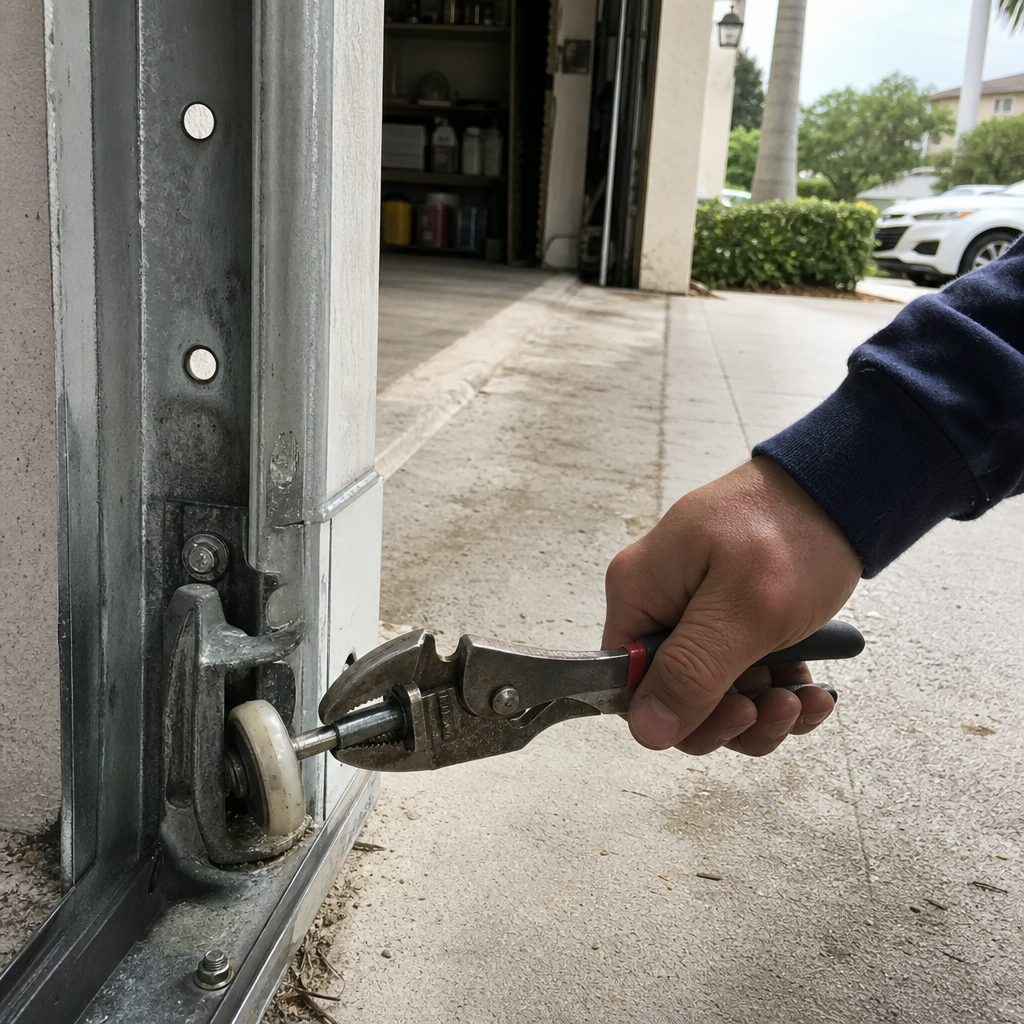
- Tracks and rollers: Aluminum tracks hold up better than steel in salt-air conditions, but steel rollers on aluminum tracks create a galvanic corrosion pair that accelerates wear on both. Nylon-wheel rollers with sealed bearings are worth the upgrade in any Miami zip code.
- Hinges and cables: Bare steel hinges pit within two to three years in waterfront properties. Stainless steel or coated hardware is the only sensible choice for anything east of the Dixie Highway corridor.
- Bottom seal and weather stripping: Salt air plus UV degrades rubber seals roughly twice as fast as in non-coastal markets. A seal that might last five years in Orlando is showing cracks and gaps in Miami in two to three.
The practical upshot: if your Miami home is within a mile of Biscayne Bay or the Atlantic coastline, you should spec every piece of hardware one grade higher than the installer’s default recommendation — and budget for a spring replacement cycle of five to seven years rather than eight to ten.
Steel vs. Aluminum vs. Fiberglass: Which Material Wins in Miami’s Climate
The honest answer is that no single material wins for every Miami property — the right choice depends on your specific location, your budget, and what you’re trying to protect against. Here’s how each material performs in South Florida conditions.
Steel Doors
Steel remains the most popular material in Miami for good reason: it’s strong, insulates well with the right core, and handles impact requirements effectively. However, steel in a coastal environment requires a high-quality paint or finish system — bare or thinly coated steel will show surface rust within three to five years in zip codes like 33139 (Miami Beach) or 33149 (Key Biscayne). Brands like Clopay and Amarr offer galvanized steel panels with factory-applied polyester finishes designed for coastal exposure. If you’re in Brickell or the Roads neighborhood, a 25-gauge steel door with a factory-applied polyester topcoat is a workable choice — but budget for a repaint or refinish cycle at the seven-to-ten-year mark.
Aluminum Doors
Aluminum is naturally corrosion-resistant and significantly lighter than steel, which reduces stress on springs, tracks, and openers in the long run. For North Miami Beach, Aventura, and Sunny Isles properties — especially those with contemporary architectural styles — aluminum full-view doors have become extremely popular. The trade-off is dent resistance: aluminum dents more easily than steel under impact, which matters in a market where windborne debris is a real seasonal consideration. Wayne Dalton and Raynor both produce aluminum door systems engineered for coastal markets with anodized finishes that hold up well against salt air.
Fiberglass Doors
Fiberglass is genuinely underused in Miami given how well it performs here. It doesn’t rust, doesn’t warp from humidity, and holds a finish well under intense UV. The downside is cost — fiberglass doors run higher upfront than comparable steel products — and availability is more limited. For waterfront properties in Coconut Grove or Coral Gables where aesthetics and long-term durability matter more than price-per-panel, fiberglass is worth a serious look.
Miami-Dade Wind-Load Requirements: What the Code Actually Requires
Miami-Dade County operates under some of the most stringent wind-load building codes in the country — and garage doors are not exempt. If you’re replacing or installing a garage door in Miami, you are legally required to use a door that meets Miami-Dade’s High-Velocity Hurricane Zone (HVHZ) standards. This is not optional, and it’s not the same standard that applies to the rest of Florida.
Here’s what that means in practice:
- NOA (Notice of Acceptance) required: Every garage door installed in Miami-Dade must carry a Miami-Dade NOA — a product approval document that confirms the door has been tested to withstand the specific wind pressures and impact conditions mandated by the HVHZ designation. If a contractor installs a door without an NOA, it will fail inspection and may void your homeowner’s insurance.
- Design pressure ratings: Miami-Dade code requires garage doors to meet specific positive and negative design pressure ratings based on the door’s size and the structure’s location. A standard residential door replacement typically needs to meet at least +40.0 psf / -50.0 psf, though corner exposures and upper-floor garages may require higher ratings.
- Impact vs. non-impact products: In certain Miami-Dade zones — particularly properties built or renovated after the 2002 Florida Building Code adoption — impact-rated doors or doors with a certified storm-bracing system are required. This is separate from the wind-load rating and is often a point of confusion during permit pulls.
- Permit required: In Miami, a permit is required for any new garage door installation or like-for-like replacement. A contractor who tells you a permit isn’t needed on a door swap is either uninformed or trying to cut corners that will cost you during a future home sale or insurance claim.
- Opener reinforcement: The garage door and opener system must work together as a code-compliant unit. An opener with insufficient force rating for a heavy impact door won’t just underperform — it can void the door’s NOA compliance in the event of a wind event claim.
Brands with strong Miami-Dade NOA product lines include Clopay, Amarr, and Wayne Dalton — all of whom manufacture doors specifically tested and approved for HVHZ installation. When James works with Miami homeowners on new installations, verifying NOA compliance is the first step, not an afterthought.
Why Garage Door Openers Degrade Faster in High Humidity — and What to Buy Instead
Miami’s average relative humidity sits between 75% and 85% for much of the year. That level of sustained moisture does specific, predictable damage to garage door opener components that most buyers and even many installers don’t account for at the point of purchase.
The main failure modes in Miami’s humidity are:
- Circuit board corrosion: The logic board inside a standard opener is not sealed for tropical conditions. In high-humidity garages — particularly detached garages or those with minimal insulation — moisture infiltrates the housing and causes micro-corrosion on circuit traces. We’ve seen Chamberlain and Craftsman openers with failed logic boards in Miami homes that were only four to five years old, well short of the projected service life in a dry climate.
- Motor winding degradation: Sustained humidity causes the motor windings to absorb moisture, which increases electrical resistance and generates excess heat during operation. The opener runs hotter, works harder, and burns out faster.
- Drive system corrosion: Chain drives are particularly vulnerable — the steel chain rusts in humid conditions, which increases noise, reduces efficiency, and accelerates wear on the sprocket and trolley. In Miami, a belt drive or screw drive system is a meaningful upgrade, not just a comfort preference. LiftMaster’s belt-drive residential line and Genie’s SilentMax series both hold up better in humid conditions than standard chain-drive units.
- Remote and keypad failures: The external keypad is the component most directly exposed to Miami’s combination of humidity, salt air, and UV. Membrane-style keypads on older Craftsman and base-model Chamberlain units degrade within three years in coastal conditions. Look for sealed keypad units with UV-resistant housings.
For Miami homeowners buying a new opener today, we’d point toward LiftMaster’s 87504 series or comparable belt-drive units from Genie — both offer DC motor technology with better heat management and drive systems that tolerate humidity with less maintenance. Pair any opener with a good surge protector; Miami’s afternoon thunderstorm season generates more surge events per year than most other U.S. metro areas.
Real Lifespan Expectations for Every Major Component in Miami
National averages for garage door component lifespans are based on average climates — which Miami definitively is not. Here’s what 18 years of working on doors across Miami actually looks like in terms of realistic service life:
- Torsion springs (coastal zip codes, east of I-95): 5–7 years vs. the 8–10 year national average. Upgrade to oil-tempered or corrosion-resistant springs to push toward the higher end.
- Torsion springs (inland areas — Kendall, Doral, Hialeah): 7–9 years. Still shorter than a dry climate, but meaningfully better than coastal exposure.
- Cables: 4–6 years in coastal Miami conditions. Stainless steel cables are available from most brands and are worth the modest price premium.
- Rollers (steel wheel): 3–5 years before corrosion impairs smooth operation. Nylon rollers with sealed bearings: 7–10 years.
- Garage door opener (chain drive): 6–9 years in Miami’s humidity. Belt drive: 9–13 years with proper maintenance.
- Door panels (steel, uncoated or standard finish): 10–15 years before rust or significant fade requires refinishing or replacement. Aluminum and fiberglass panels: 15–20+ years in the same environment.
- Bottom seal: 2–3 years in coastal areas before cracking. Budget for it as a regular maintenance item, not a one-time installation.
- Weatherstripping (side and top): 3–5 years in Miami’s UV before brittleness sets in.
A Miami-Specific Maintenance Schedule That Actually Works
Generic maintenance schedules say “lubricate annually.” In Miami, annual isn’t enough for some components and is the wrong cadence for others. Here’s a Garage Door Repair Maintenance Checklist for Miami Homeowners built for South Florida conditions:
- Every 3 months — visual hardware inspection: Look at springs, cables, and tracks for surface rust, fraying, or corrosion discoloration. In Coconut Grove or Coral Gables homes with older doors, this quarterly check has caught cracking cables before they failed. Five minutes with a flashlight is cheaper than an emergency call.
- Every 3 months — bottom seal check: Press the door closed and look for daylight or feel for airflow along the floor seal. Miami’s afternoon rainstorms will find every gap — and water intrusion accelerates floor rust on steel-panel bottoms.
- Every 6 months — full lubrication cycle: Apply a silicone-based lubricant (not WD-40) to hinges, rollers, springs, and the torsion bar bearing plates. In humid conditions, petroleum-based lubricants attract particulate and gum up faster than silicone. LiftMaster and Clopay both make lubricant formulas designed for their hardware.
- Every 6 months — opener force and auto-reverse test: Place a 2×4 flat on the ground under the door. The door should auto-reverse upon contact. In humid conditions, motor performance drifts — this test catches a sluggish opener before it becomes a safety issue or a motor burnout.
- Annually — professional inspection: A trained eye catches things a homeowner walk-around misses: spring tension calibration, cable drum wear, track alignment, and opener torque settings. After 18 years servicing doors across Miami, James has seen how a $150 annual tune-up routinely prevents $600 spring replacement emergencies.
- After every hurricane season (November): Check all hardware for salt residue buildup from storm surge events. Rinse tracks and hardware with fresh water if any storm brought salt spray into the garage bay. Relubricate after rinsing.
Common Mistakes to Avoid
- Buying a non-NOA door to save money upfront. In Miami-Dade, a door without a Notice of Acceptance will fail the permit inspection and may not be covered by your homeowner’s insurance during a wind event. The cost of pulling a door and reinstalling a code-compliant one far exceeds the savings on the original purchase.
- Using WD-40 to lubricate springs and rollers. WD-40 is a solvent and a moisture displacer, not a lubricant — it strips the thin oil film off springs and leaves them more vulnerable to corrosion. In Miami’s humidity, this mistake accelerates spring failure noticeably. Use a dedicated silicone or lithium-based garage door lubricant.
- Ignoring early rust on hardware because the door still works. Surface corrosion on a spring or cable in Miami’s salt air environment isn’t cosmetic — it’s a sign of deeper oxidation that has already compromised the metal’s tensile strength. A spring that looks “a little rusty” may be 40% weaker than a new one. Don’t wait for a failure to act.
- Installing an opener rated for a standard door on a Miami-Dade impact door. HVHZ impact doors are heavier than standard residential doors — often by 30% to 50%. An undersized opener will burn out faster and may not produce the force required by the door’s NOA compliance conditions. Always match the opener’s HP rating to the door’s actual weight.
- Skipping the permit on a replacement door because it’s “just a swap.” A like-for-like door replacement in Miami requires a permit. Unpermitted work surfaces during home sales and can trigger insurance coverage disputes after wind damage. The permit process exists precisely because the HVHZ standards matter here.
- Choosing steel hardware over corrosion-resistant alternatives to save a few dollars. In Brickell, Edgewater, or anywhere within a half mile of the bay or ocean, the upcharge for stainless steel cables and coated hardware pays for itself in avoided replacement costs within three to four years.
- Deferring a broken spring repair because the door still opens manually. Operating an opener against an unbalanced spring load damages the opener motor and trolley assembly. What starts as a spring repair becomes a spring-and-opener repair if you run the motor on a compromised spring for more than a few cycles.
When to Call a Professional
Some garage door tasks are genuinely DIY-friendly: lubricating hinges, replacing a weather seal, reprogramming a remote. Others aren’t — and in Miami specifically, the consequences of a mishandled repair are worse than in markets without active hurricane seasons and strict code enforcement. Read our guide on How to Hire a Garage Door Contractor in Miami: A Step-by-Step Guide before you decide.
Call a professional when you see:
- A broken or visibly corroded torsion or extension spring — spring replacement involves high-tension components that cause serious injury when handled without the right tools and training.
- A door that won’t auto-reverse or reverses inconsistently — this is a safety code issue, not just an inconvenience.
- Cables that are fraying, kinked, or have jumped off the drum.
- Significant track misalignment — a bent track in a Miami home that sees hurricane-season wind loads will fail at the worst possible moment.
- Any new installation that requires a Miami-Dade permit and NOA verification.
- An opener that strains, hesitates, or smells hot — motor issues don’t resolve on their own.
Sterling Garage Door Service North Miami offers free estimates across Miami — call (754) 666-7745 and James will give you a straight answer on what the repair actually involves before any work begins.
Frequently Asked Questions
Most garage door repairs in Miami fall between $150 and $450, depending on what’s broken. A single torsion spring replacement typically runs $200–$340 in the Miami market; cable replacements run $150–$250; opener repairs vary more widely based on whether it’s a board replacement or a full unit swap. Miami-specific factors — the need for corrosion-resistant parts, heavier impact-rated door components — push costs slightly above national averages. Call (754) 666-7745 for an exact quote; estimates are free.
Yes. In Miami-Dade County, a permit is required for any garage door replacement, including like-for-like swaps. See Garage Door Permits, Codes & Inspections in FL: What You Need to Know for full details. The door must carry a Miami-Dade Notice of Acceptance (NOA) to pass inspection, and the installation must comply with HVHZ wind-load standards. Any contractor who tells you a permit isn’t needed on a standard replacement is giving you incorrect information — and the downstream consequences during a home sale or insurance claim are real.
In coastal Miami zip codes — Miami Beach, Brickell, Key Biscayne, Edgewater — plan for a spring replacement cycle of five to seven years. In inland areas like Kendall, Doral, or Hialeah, springs typically last seven to nine years. These ranges are shorter than national averages because salt air and humidity accelerate metal fatigue. Upgrading to oil-tempered or corrosion-resistant springs at replacement time extends the next cycle.
Aluminum and fiberglass outperform standard steel in Miami’s humidity and salt-air environment over the long term. Steel remains the most cost-effective choice if you select a product with a factory-applied galvanized coating and polyester topcoat finish — Clopay and Amarr both make steel lines rated for coastal exposure. For waterfront properties in Coconut Grove, Coral Gables, or Miami Beach, fiberglass or quality aluminum is worth the higher upfront cost because it eliminates the rust and warping concerns entirely. For more on installation options, see our Garage Door Installation in Miami Beach page.
Not all openers handle Miami’s humidity equally. Belt-drive openers — particularly LiftMaster’s DC belt-drive line and Genie’s SilentMax series — hold up better than standard chain-drive units in high-humidity conditions because the drive system doesn’t corrode the way a steel chain does. Pair any opener with a surge protector, given Miami’s afternoon thunderstorm frequency. Avoid undersized openers on impact-rated doors: HVHZ doors run heavier than standard residential panels and require an opener rated for the actual door weight. For opener-specific guidance, visit our Garage Door Opener in Miami Beach page.
The general rule: if the door panels are structurally sound and the door meets current Miami-Dade NOA requirements, repair is almost always the better value — springs, cables, openers, and hardware are replaceable components. If the door was installed before Miami-Dade adopted HVHZ standards in the early 2000s and doesn’t carry an NOA, replacement makes more sense because you’re one wind event away from a coverage dispute with your insurer. We cover this decision in detail on our Garage Door Repair in Miami Beach page. Still not sure? Call (754) 666-7745 — James will give you an honest read on whether a repair makes sense or whether replacement is the smarter move.
The Bottom Line
Garage door ownership in Miami operates by a different set of rules than anywhere else in the country. Salt air cuts hardware lifespans nearly in half in coastal zip codes. Miami-Dade’s HVHZ code requirements are non-negotiable and non-optional. Humidity kills openers and corrodes springs on a schedule that national manufacturers don’t advertise. The right material for a Brickell high-rise garage differs from the right choice for a Hialeah single-family home. And a maintenance schedule built for Orlando doesn’t protect a door in Miami. Know the local rules, spec accordingly, and you’ll own a garage door that does its job through every hurricane season without expensive surprises.
Ready to Talk to Someone Who Knows Miami Doors?
James Johnson has been diagnosing and repairing garage doors across Miami for 18 years — with 4.9 stars across 432 verified reviews, he’s the person behind every job, not a rotating crew. Whether you need a spring replacement, a new HVHZ-compliant door installation, an opener upgrade, or an emergency same-day repair, call (754) 666-7745 for a free estimate. Straight answers, no upsells, and the kind of institutional knowledge that only comes from 18 years and thousands of Miami doors.
Written by James Johnson, Owner & Lead Technician at Sterling Garage Door Service North Miami, serving Miami since 2008.